> For the complete documentation index, see [llms.txt](https://help.gleantap.com/llms.txt). Markdown versions of documentation pages are available by appending `.md` to page URLs; this page is available as [Markdown](https://help.gleantap.com/audience/segment-report.md).
# Segment Report
How to review existing reports and build new reports within a segment
When you click on a segment, there are multiple built-in reports that you can use. However, you can also create custom reports to get additional insights. Let's review both of those options.
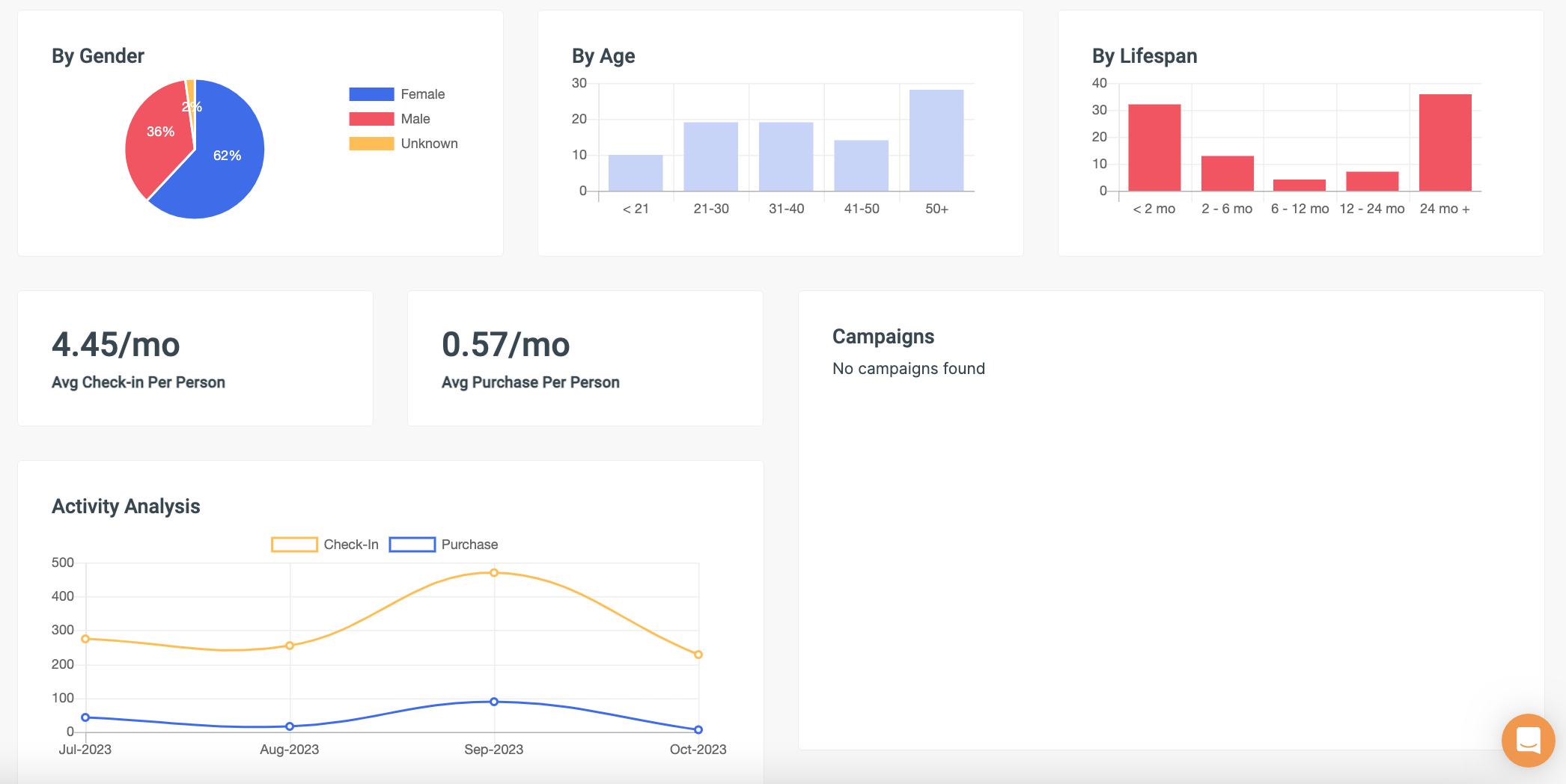
**Built-in reports:** The reports that come with every segment show a breakdown of the segment in question by Gender, Age, Lifespan (amount of time in the CRM), Average Check-ins Per Person, Average Purchase Per Person, as well as a chart of their activity and a list of the campaigns that the segment is being used for.
**Custom Reports:** To create a custom report within a segment, click on the 'New Report' button on the top right of the account.
When you do, it will open this menu.
For the report, you have a few options.
**Title** is simply the name of your report.
**Type** can be either a Conversion Metric, showing how many people in the segment have converted based on another attribute, or an Aggregate List which shows you a grouping based on a metric within a segment.
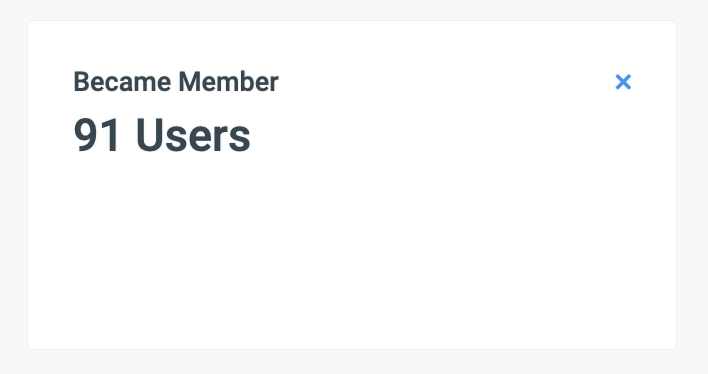
Here is an example of a Conversion Metric for a Leads Segment that shows how many users became members after showing as a lead.
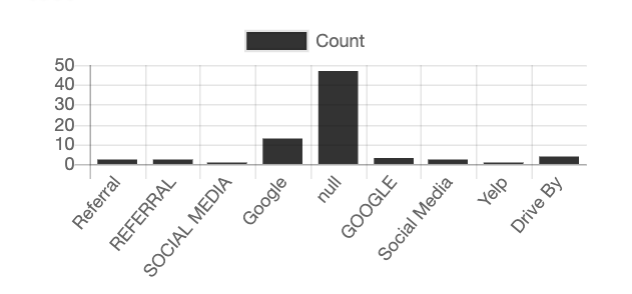
And here is an example of an Aggregate List report showing
**Group by** is the attributes that you are running the report based off of. Make sure that these attributes are relevant to ensure your reports work correctly.
---
# Agent Instructions
This documentation is published with GitBook. GitBook is the documentation platform designed so that both humans and AI agents can read, navigate, and reason over technical content effectively. Learn more at gitbook.com.
## Querying This Documentation
If you need additional information that is not directly available in this page, you can query the documentation by asking a question.
Perform an HTTP GET request on the following URL with the `ask` and `goal` query parameters:
```
GET https://help.gleantap.com/audience/segment-report.md?ask=&goal=
```
`ask` is the immediate question: it should be specific, self-contained, and written in natural language.
`goal` is what the user is ultimately trying to achieve, the reason they need the answer. Sharing it helps GitBook give you a better, more relevant answer. A goal is most helpful when it describes the outcome the user wants rather than restating the question. For example, with `ask=how do I create an API token`, a goal like `automate deployments from our CI pipeline` lets GitBook tailor the answer to that use case.
The response will contain a direct answer to the question and relevant excerpts and sources from the documentation.
Use this mechanism when the answer is not explicitly present in the current page, you need clarification or additional context, or you want to retrieve related documentation sections.